Let's talk about the 5 5 5 rule for newborns. If you're a new parent drowning in Google searches and conflicting advice, this one might cut through the noise. It's not about the baby's schedule—it's about yours. Specifically, the birthing parent's recovery. The rule suggests a structured 15-day plan: 5 days in the bed, 5 days on the bed, and 5 days around the bed. Sounds simple, maybe even luxurious. But as someone who's been through the newborn fog twice, I can tell you its power lies in setting realistic, protective boundaries when you're at your most vulnerable. It's a framework for healing, not a rigid law.
What You'll Find in This Guide
What Exactly Is the 5 5 5 Rule?
The 5 5 5 rule is a postpartum recovery guideline. It breaks down the first two critical weeks after birth into three distinct phases, each lasting roughly five days. The goal is to prioritize physical healing and bonding by minimizing unnecessary activity and stress.
The Core Breakdown:
First 5 Days (IN the bed): Your primary domain is the bed. You are resting, feeding your baby, sleeping, and recovering from the birth itself—whether vaginal or cesarean. Bathroom trips are the main exception. Meals are brought to you. Your job is to exist, heal, and connect with your newborn.
Next 5 Days (ON the bed): You can now sit on the edge of the bed or move to a nearby comfortable chair (like a nursing chair). You might start doing very gentle activities here, like reading a short story to an older sibling or folding a tiny pile of baby clothes. The key is you're not pacing the house or doing chores.
Final 5 Days (AROUND the bed): You can now move about the room where your bed is. Think walking to the ensuite bathroom for a shower, pacing slowly with a fussy baby, or organizing your bedside table. You are not yet venturing downstairs to do laundry or cook dinner.
This rule has gained traction through word-of-mouth and parenting communities online, often framed as traditional or midwife-endorsed wisdom. While its exact origins are fuzzy, the principle aligns with postpartum care practices recommended by organizations like the American College of Obstetricians and Gynecologists (ACOG), which emphasize rest and graduated return to activity.
Why the 5 5 5 Rule Actually Works (The Science Behind the Simplicity)
It works because it fights against our worst modern instinct: to bounce back immediately. After major abdominal surgery (a C-section) or a significant physical event (vaginal birth), your body needs to repair. The placenta leaves a wound the size of a dinner plate inside your uterus. Ligaments are loose. Hormones are crashing.
Here’s the part most articles don't stress enough: the rule isn't just about physical healing. It's a psychological guardrail. It gives you and your partner/family a clear, shared script. When grandma asks "what can I do?", you can say, "I'm on day 3, so I'm in bed. Could you please bring up some lunch and take the trash down?" It removes the guilt of "not doing anything" by reframing rest as the primary, essential task.
I made the mistake of skipping this structure with my first. By day four, I was unloading the dishwasher. By week two, I was exhausted, weepy, and my recovery felt prolonged. With my second, we loosely followed the 5 5 5 framework. The difference in my energy and emotional state was night and day. It created the space for my body to actually heal.
How to Follow the 5 5 5 Rule Day-by-Day: A Practical Blueprint
Let's get concrete. What does this actually look like in a messy, real-life home with a newborn who doesn't know it's "day 4"?
Phase 1: Days 1-5 (IN the Bed) – The Survival & Connection Zone
Your bed is your command center. Prepare it before birth: extra pillows, a large water bottle with a straw, phone charger, snacks, remote control, burp cloths, diapers, and wipes within arm's reach (a bedside caddy is perfect).
What you DO: Breastfeed or bottle-feed. Sleep when the baby sleeps (yes, that cliché). Eat nourishing meals brought to you. Take pain medication on schedule. Do your gentle postpartum pelvic floor exercises (like kegels) if cleared by your provider. Skin-to-skin contact. Stare at your baby.
What you DO NOT DO: Get up to fetch things. Host visitors. Cook. Clean. Go up and down stairs. Feel guilty.
This phase is about accepting that your only output is milk (if breastfeeding) and love. Everything else is input for you.
Phase 2: Days 6-10 (ON the Bed) – The Gentle Re-engagement Zone
You can now sit upright on the edge of the bed or transfer to a cozy chair in the same room. Your world expands by about three feet.
What you CAN add: Very short, seated activities. Maybe you brush your hair properly. You might video call a friend for 10 minutes. You could read a board book to your baby. The emphasis is still on rest, but with a slight shift in posture and mental stimulation.
The subtle mistake to avoid: Don't let "on the bed" become "working from the bed." Checking work emails or paying bills online is mental labor that can spike stress hormones. This phase is for gentle engagement, not productivity.
Phase 3: Days 11-15 (AROUND the Bed) – The Room-Level Reintegration Zone
Now you can move slowly around your bedroom. Walk to the window. Take a longer shower. Organize the changing station. The key is that your primary resting place (the bed) is still the hub, and you haven't entered the general household flow.
Why this phase is crucial: It tests your stamina in a controlled environment. How do you feel after a 5-minute shower? Do you feel lightheaded walking to the dresser? It's a safe space to listen to your body before tackling the stairs or the kitchen.
| Phase | Primary Location | Key Activities | Absolute No-Nos |
|---|---|---|---|
| Days 1-5 | IN the Bed | Resting, feeding baby, sleeping, eating in bed, skin-to-skin. | Walking around the house, chores, hosting. |
| Days 6-10 | ON the Bed (or bedside chair) | Gentle seated activities, short calls, light reading. | Standing for long, household tasks, mental work. |
| Days 11-15 | AROUND the Bedroom | Walking in the room, longer self-care, organizing baby items in the room. | Leaving the bedroom floor for chores, lifting heavy items. |
Common Mistakes and How to Avoid Them
Seeing the 5 5 5 rule as a strict calendar is the first error. It's a guide, not a gospel. If you have a toddler, day 3 might require you to walk to the living room to give a hug. That's okay. The spirit is to minimize, not eliminate.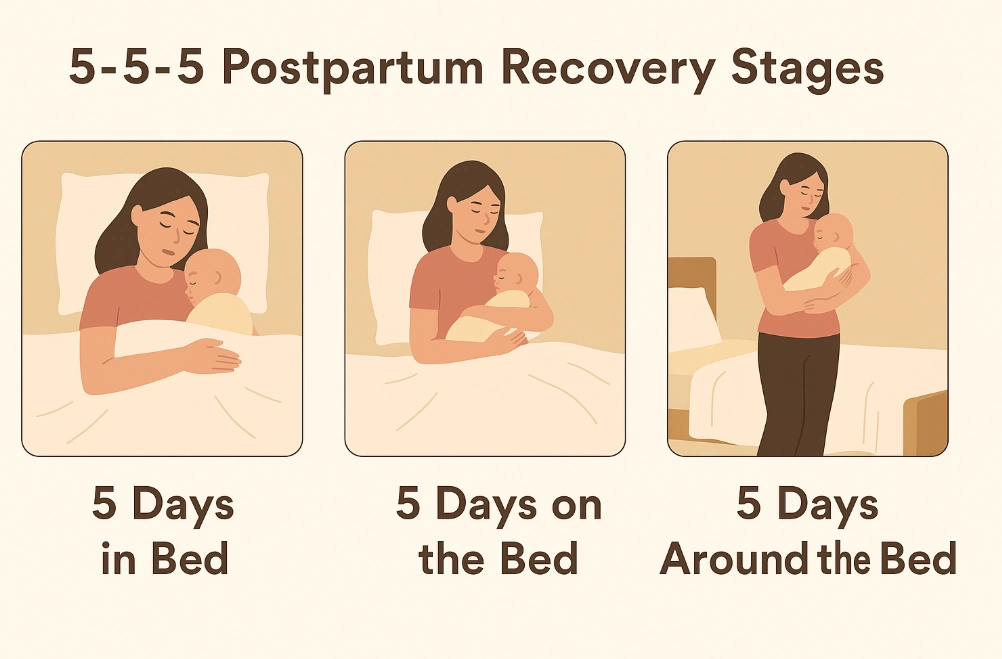
The bigger mistake is not preparing your support system. This rule requires help. You must have a partner, family member, friend, or postpartum doula who understands the plan and is on board to handle cooking, cleaning, older children, and bringing you things. Have a family meeting about this before the baby arrives. Show them this article.
Another pitfall is comparing your "bed" phase to someone else's social media "back-to-normal" phase. Ignore that. Your job is healing. A study published in the Journal of Perinatal Education emphasizes that adequate rest is directly linked to better postpartum mental health outcomes. You're not being lazy; you're being strategic.
Your 5 5 5 Rule Questions Answered
 What if I have other children? This seems impossible.
The 5 5 5 rule for newborns is less about the baby and more about gifting the birthing parent a structured, permission-based recovery plan. It won't be perfect. Some days will blend. But having that framework—5 days in, 5 on, 5 around—creates a powerful mindset shift. It tells you that your healing is the priority, that rest is productive, and that this incredibly fragile, short season deserves protection. Start by preparing your bed and your people. The rest, quite literally, will follow.
Reader Comments