Quick Guide
- First, Let's Untangle the "1 Month" Confusion
- The Body's Early Whispers: Symptoms at 1 Month (4-5 Weeks)
- The Deciding Factor: Pregnancy Tests and Their Timing
- What If The Test Is Negative, But I Still Think I Am?
- What If The Test Is Positive?
- When Should You Definitely See a Doctor Sooner?
- Common Questions (Because You'll Probably Have Them)
- Final Thoughts: Navigating the Uncertainty
Let's get straight to the point. That question, "Can I know I'm pregnant at 1 month?", is spinning in your head right now. Maybe your period is late. Maybe you just have a gut feeling. Or maybe you're trying to conceive and analyzing every little twinge. The wait is agonizing, and Dr. Google often makes it worse with conflicting information.
I remember a friend texting me at 2 AM, convinced she was pregnant because she felt nauseous after dinner. The uncertainty is real, and it's stressful. So, let's cut through the noise. This isn't a dry medical textbook chapter. We're going to walk through this step-by-step, like we're having a coffee and figuring it out together.
The Short, Direct Answer: Yes, it is absolutely possible to know you're pregnant at what is commonly called "1 month." But—and this is a huge but—the timing is tricky and depends entirely on how you're counting. Confusion about pregnancy dating is the number one reason people get frustrated with early testing.
First, Let's Untangle the "1 Month" Confusion
This is where most articles lose people. When you say "1 month pregnant," what do you actually mean? Medicine doesn't measure pregnancy from the date of conception in the way we naturally think. Instead, doctors use a system called gestational age.
Here’s the kicker: Your "first month" of pregnancy starts on the first day of your last menstrual period (LMP), before you've even ovulated or conceived. I know, it sounds backwards. It's a historical convention that stuck because most people know their LMP date better than their ovulation date.
Let's break it down with a real example: Say your last period started on January 1st. You ovulate and conceive around January 14th. By the time you miss your period around January 29th, you are already considered about 4 weeks pregnant in medical terms, even though conception only happened about 2 weeks prior. So when you ask "can I know I'm pregnant at 1 month?", you're likely already in that 4-week window.
This dating method means that by the time you get a positive test, you're often already considered 4-5 weeks along. It's weird, but it's the standard. The American College of Obstetricians and Gynecologists (ACOG) provides clear resources on this dating method, which you can find on their patient education website.
The Body's Early Whispers: Symptoms at 1 Month (4-5 Weeks)
Before any test turns positive, your body might start sending signals. These aren't the dramatic movie-style symptoms. They're subtle, easy to miss, and frustratingly similar to PMS. Here’s what some people notice around that 4-5 week mark:
- Implantation Bleeding: A light spotting or pinkish discharge 10-14 days after conception. It's much lighter than a period and lasts a day or two. Not everyone gets this.
- Breast Changes: Tenderness, heaviness, or a tingling sensation. Your areolas (the area around the nipple) might look darker or have little bumps become more pronounced.
- Fatigue: Not just tired, but a deep, bone-weary exhaustion that hits you out of nowhere in the afternoon.
- Heightened Sense of Smell: Suddenly, the coffee machine at work smells revolting, or you can smell your neighbor's dinner from three doors down.
- Frequent Urination: Thanks to early hormonal shifts and increased blood flow to your pelvis, you might be making more trips to the bathroom.
- Mild Cramping: Similar to period cramps but often lower and more central. This can be from the uterus beginning to stretch.
A word of caution: You can have all of these and not be pregnant. You can also have none of these and be pregnant.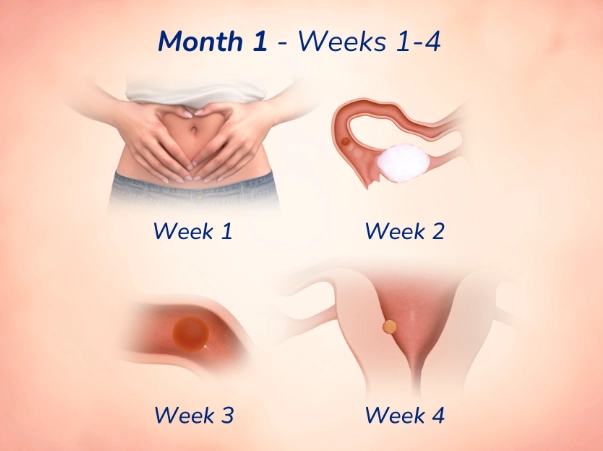
My friend who felt nauseous? It was just a rich meal. Our brains are fantastic at connecting dots, especially when we're hoping or worrying for a specific outcome. Symptom-spotting is a real emotional rollercoaster.
The Deciding Factor: Pregnancy Tests and Their Timing
Symptoms are clues, but tests are evidence. This is the core of "can I know I'm pregnant at 1 month?" The answer hinges on understanding how these tests work.
How Home Pregnancy Tests Actually Work
They detect a hormone called human chorionic gonadotropin (hCG). This hormone is produced by the cells that will eventually form the placenta. It starts entering your bloodstream almost immediately after implantation (when the embryo attaches to your uterine wall).
Here’s the critical timeline:
| Event | Approximate Timing | hCG Level & Test Readiness |
|---|---|---|
| Ovulation & Conception | ~ Day 14 of Cycle | hCG: 0. Not detectable. |
| Implantation | 6-12 days after conception | hCG production begins. Levels are very low ( |
| Early Detection Possible | 3-4 days before missed period | Some sensitive tests (~10-25 mIU/mL sensitivity) may show a faint line. High chance of false negative. |
| Missed Period Day | ~ Day 29 of Cycle | hCG typically >50 mIU/mL. Most standard tests are >99% accurate from this day. |
| "1 Month" (4 Weeks) | 7 days after missed period | hCG rising rapidly. A clear positive is very likely if pregnant. |
So, can you test positive at 1 month? If by "1 month" you mean around 4 weeks gestational age (which is right when your period is due or just after), then yes, a test is very likely to be accurate.
The Big Test Mistakes Everyone Makes
Testing too early is the classic error. That negative on day 10 post-ovulation doesn't mean anything. It's just too soon. The other mistake is reading the test outside the time window. An "evaporation line" that appears after 10 minutes is not a positive. It's just the dye drying.
Important: If you have irregular cycles, counting from the first day of your last period is unreliable. You might be testing way too early because you ovulated later than a textbook 28-day cycle assumes. It’s better to count from the day you think you ovulated or conceived, then add about two weeks before a test is likely to be definitive.
What If The Test Is Negative, But I Still Think I Am?
This is a massive source of anxiety. You feel different, your period is MIA, but the stick says no.
Could it be a false negative?
Absolutely. The most common reason is testing too early. Your hCG just hasn't reached the test's detection threshold yet. Other reasons include diluted urine (test with first-morning urine, it's most concentrated), using an expired test, or not following the instructions properly.
So, if you get a negative but your period still hasn't shown up in a week, test again. Your body might just be on a slower schedule.
Could it be something else?
Unfortunately, yes. A missed or late period with negative tests can be caused by stress, significant weight loss or gain, excessive exercise, thyroid issues, Polycystic Ovary Syndrome (PCOS), or perimenopause. If this pattern continues, it's worth talking to a doctor to rule out underlying conditions. Information from reputable sources like the NHS can provide a balanced overview of potential causes.
What If The Test Is Positive?
Congratulations! Your question, "Can I know I'm pregnant at 1 month?" has been answered with a resounding yes.
Your next steps are crucial:
- Start Taking Prenatal Vitamins if you aren't already. Folic acid is critical in these very early weeks for neural tube development.
- Call Your Doctor or Midwife. They won't usually see you right away. Most first prenatal appointments are scheduled for around 8 weeks gestation. But it's good to get on their schedule and get any preliminary instructions.
- Avoid Harmful Substances. This means no alcohol, smoking, or recreational drugs. Be cautious with medications—check with your doctor before taking anything, even over-the-counter drugs.
- Listen to Your Body. Rest when you're tired. Eat small, frequent meals if nausea strikes. Stay hydrated.
I'll be honest, the wait between that positive test and the first doctor's appointment can feel longer than the initial two-week wait. You're bursting with news but told to wait. It's a strange limbo.
When Should You Definitely See a Doctor Sooner?
While most early pregnancies progress normally, be aware of red flags. Contact a healthcare provider immediately if you experience:
- Severe abdominal pain or cramping on one side (could indicate an ectopic pregnancy, a medical emergency).
- Heavy bleeding that soaks through a pad in an hour, especially if accompanied by clots or tissue.
- Severe dizziness, fainting, or shoulder tip pain (also signs of a possible ectopic pregnancy).
- Persistent, severe vomiting where you can't keep any food or liquids down (Hyperemesis Gravidarum).
Trust your instincts. If something feels very wrong, don't wait. Seek medical attention. Reputable medical portals like Mayo Clinic offer reliable information on when to seek emergency care.
Common Questions (Because You'll Probably Have Them)
I had unprotected sex a week ago. Can I test now?
No. It's way too early. Implantation hasn't even happened yet. You need to wait at least until the day of your expected period, or about 14 days after sex, for an accurate result.
My test is faint. Is it positive?
Yes. Any line, even a faint one, means the test is detecting hCG. A faint line often means you are very early. Take another test in a couple of days, and the line should be darker as your hCG levels rise.
Can stress delay my period and cause false symptoms?
Absolutely. Stress can wreak havoc on your hormones, delaying ovulation and thus your period. It can also cause fatigue, breast tenderness, and even nausea. It's a cruel trick the body plays.
Are digital tests more accurate than line tests?
Not necessarily. They use the same technology to detect hCG. The digital readout just removes the ambiguity of reading a faint line. However, some digital tests are less sensitive than their line counterparts, so they might not detect pregnancy as early. Always check the sensitivity (mIU/mL) on the box.
I have PCOS. Is all this timing different for me?
Yes, it can be. With PCOS, ovulation is often irregular or absent, making it very hard to know when to expect your period. Tracking ovulation with ovulation predictor kits (OPKs) or basal body temperature (BBT) charting becomes much more important to know when to test accurately.
Final Thoughts: Navigating the Uncertainty
So, can you know you're pregnant at 1 month? The medical answer is clear: yes, it is very possible to get a reliable positive test result around the time of a missed period, which is medically considered about 4 weeks pregnant.
But the emotional journey is murkier. The wait is filled with hope, fear, and over-analysis. My biggest piece of advice? Try to distract yourself. Obsessively symptom-spotting or testing daily from 7 days past ovulation will only drive you crazy.
Mark the day your period is due on the calendar. Test that morning if you must. If it's negative and your period still doesn't come, wait a few days and try again. Give your body time to do what it needs to do.
Remember, a single late period or a negative test isn't the whole story of your fertility. Our bodies are complex. Whether you're hoping for a positive or dreading one, be kind to yourself during this waiting game. The answer will come in time.
I hope this guide has taken some of the mystery and anxiety out of that burning question. You're not alone in asking it. Take a deep breath. You've got this.
Reader Comments